

Overview
Note: This is an updated version of an earlier post: “Best Music Technology Books” that I wrote in 2017. I’ve amended that list and added some more recently-published editions and new resources.
I love buying books – both digital and paper – especially when they are relevant and useful. Here are a number of music technology in education books I recommend. I own almost all of these books and they contain excellent ideas for music technology curriculum integration. Please note that some of the links below are affiliate links which will earn me a very small commission (at no extra cost to you!). These are all books that I recommend because they are quality resources and any commissions earned go back into supporting the upkeep of this site.
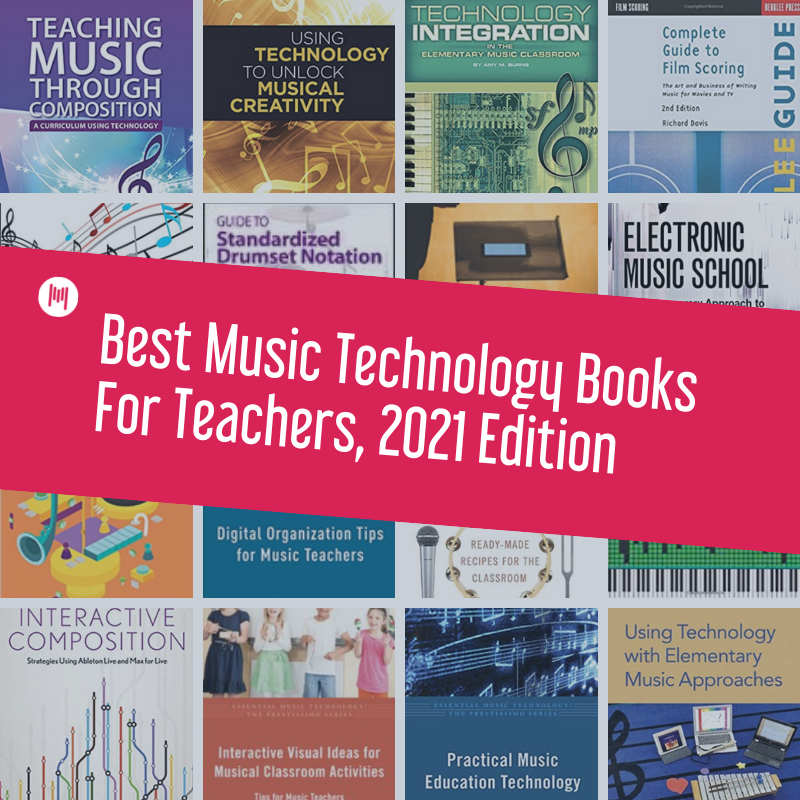
| 1. Barbara Freedman’s Teaching Music Through Composition: A Curriculum Using Technology contains practical step-by-step lessons focussing on composition. There are lesson plans and student project sheets which will help you implement her ideas straight away. |  |
| 2. Like Barbara Freedman’s book, Dr Scott Watson’s Using Technology to Unlock Musical Creativity includes lesson plan ideas with step-by-step instructions for using music software in the classroom. In addition, Dr Watson provides background information and the reasoning behind the integration of technology in music education. |  |
| 3. Technology Integration in the Elementary Music Classroom by Amy Burns. One of the rare books that outlines ideas for using technology with young students. Author Amy Burns and the other contributors provide lesson plans that integrate technology with singing, playing and literacy activities using a variety of software programs and tech tools. |  |
| 4. Complete Guide to Film Scoring (Berklee Guide)by Richard Davis. If you’re interested in pursuing film scoring with your students this book is a fascinating read. |  |
| 5. Guide to Standardized Drumset Notationby Norman Weinberg. Published by the Percussive Arts Society, this book gives an insight into creating clear, readable drum patterns. My go-to drum notation guide. |  |
| 6. Composing Music For Video Games is a useful guide for composing game music itself and also launching a career as a game music composer. Author Chance Thomas gives some great step-by-step techniques and tips. |  |
| 7. A Composer’s Guide To Game Music by Winifred Phillips is another award-winning book on the topic of composing music for video games. She has practical tips and advice for would-be game composers. |  |
| 8. Recording Tips For Music Educators by Ronald E. Kearns aims to provide practical advice for music educators who wish to record their school groups. Suitable for complete beginners as well as those more comfortable with technology, it helps with the planning and execution of all the different components of a school recording project. |  |
| 9. Digital Organisation Tips for Music Educators by Robby Burns is a guide to managing all of the “other” parts of the music teaching role – planning trips, finances, logistics, arranging and composing and more. This book will help you navigate the many technology solutions for increasing productivity in your professional life. |  |
| 10. The Oxford Handbook of Technology and Music Education by Alex Ruthmann and Roger Mantie is a handbook detailing the way technology integrates and intersects with music education. Contributions to the chapters of the book have been made by a range of experts in the field. |  |
| 11. The Music Technology Cookbook by Adam Patrick Bell is a complete guide to music tech lessons for students of all different levels with ideas from music teachers around the globe. The book is organized into five sections— Beat Making and Performance; Composition; Multimedia and Interdisciplinary; Production; Programming— which are then organized by levels beginner, intermediate, and advanced. |  |
| 12. Electronic Music School: A Contemporary Approach to Teaching Musical Creativity by Will Kuhn and Ethan Hein is a wonderful guide for secondary teachers looking to create a music technology program in their schools. It includes guides for preparing your classroom, curricula topics, and ideas for furthering the reach of your students’ music technology compositions in the community. |  |
| 13. Interactive Composition: Strategies Using Ableton Live and Max for Live by V.J. Manzo and Will Kuhn uses Ableton Live and Max for Live as the primary tools to teach electronic composition in a variety of styles. It is a wonderful, interactive guide that walks through composing in different musical styles and genres and teaches how to use the two programs to develop musical ideas using different tools within each program. |  |
| 14. Interactive Visual Ideas for Musical Classroom Activities: Tips for Music Teachers by Catherine Dwinal gives music teachers tips, ideas, and resources for using projectors, smart whiteboards, document cameras and more! This is a perfect starter book for music teachers who want to increase their usage of technology but aren’t quite sure where to start. |  |
| 15. Practical Music Education Technology by Richard Dammers and Marjorie LoPresti helps conquer the music-technology-overwhelm. In this book, music teachers will get helpful lesson plan ideas, free resources, and easy how-to implementation guides suitable for a range of classroom budgets. |  |
| 16. Technology Tips for Ensemble Teachers by Peter J. Perry dives specifically into technology that aids in the direction of large-group ensembles. His book offers content-specific examples for technologies in band, orchestra, jazz ensemble, and chorus instruction, as well as percussion ensembles, guitar ensembles, rock bands, a capella groups, and iPad ensembles. If you are a director of an ensemble and need some music technology direction, this is the book for you! |  |
| 17. Using Technology with Elementary Music Approaches is another book written by our very own community coordinator, Amy M. Burns. In this book, Amy dives deep into how to practically and authentically use technology in a range of elementary/primary classroom settings. Whether you are 1:1 with student devices or have just one device for your classroom, Amy has ideas for how to engage your students with technology. |  |
Download your copy
Would you like to take a copy of this with you? Click the button below and a copy of this will be sent directly into your inbox.
Looking for More Resources for Music Teachers?
Hello! I’m Katie Argyle – an Australian music technology trainer and consultant with a passion for helping music teachers through my business Midnight Music.
I’m a qualified teacher but no, I don’t currently teach in a school. I help teachers through my online professional development space – the Midnight Music Community – where there are tutorial videos, courses, links and downloadable resources.

I like to focus on easy ways to incorporate technology into what you are already doing in your music curriculum through a range of creative projects. I also run live workshops and have presented at countless conferences and other music education events.
If you want simple, effective ideas for using technology in music education, I would LOVE to help you inside the Midnight Music Community.




One Comment
Thanks for the great list!
Another recent music technology book I like is “Scratch Music Projects” by Andrew R. Brown and S. Alex Ruthmann. (Published 2020).