


This is a guest post by one of our teacher authors, Katrina Proctor. She is also the Content Manager at Midnight Music.
Overview
Music theory is one of the most crucial aspects of our students’ development in our music classrooms. Of course, music creation, performance, and experience have their own critical role to play too, but students have far more of an appreciation for music when they can hear AND understand the mechanics of music.
There are many music theory websites that are designed to help you teach the most basic to most advanced aspects of music theory to your students. Whether you are looking for a detailed theory lesson or just a simple game to reinforce a basic concept, these websites have what you need to make your students’ understanding more concrete.
MusicTheory.Net
Best for: Secondary Music Classrooms
It still amazes me that some teachers have never heard of or used musictheory.net. MusicTheory.net has a range of exercises and pre-made digital lessons that walk students through the basics of music theory (rhythm, notes on the staff, time signatures etc.) all the way through building chord progressions, building neapolitan chords, and inversions.

One of the best features of musictheory.net is its exercise customizer for teachers. In the customizer, teachers can pre-make their own exercises and parameters for their students. For example, perhaps a class is learning about the space notes of the treble clef. The teacher could design a note identification quiz that will only ask students about the space notes of the treble clef. The teacher can also set parameters such as time limit, question limit, and allowing multiple attempts.
Once the exercise is designed, it is saved as a private link to be added to digital classrooms or distributed via email. When students click on the link, all of the pre-set parameters are right there waiting for them which dramatically decreases set-up time for exams or quizzes. Although there is no way to view all students’ scores outright, you can request students to send you their completion report once they’ve completed the quiz.
This fully-featured website is completely free!

Musicca.com
Best for: Primary/Secondary Music Classrooms (virtual instruments) & Secondary Music Classrooms (theory)
Musicca.com is similar to musictheory.net in terms of their theory exercises, but they also have other features which make them unique and useful in their own right.
The best feature (in my opinion) of musicca.com is their virtual instruments and finder tools for chords, intervals, and scales. Musicca offers a free virtual piano, virtual guitar, virtual bass guitar, and an online drum machine. It’s not easy to find virtual instruments whose sounds are high quality, but the virtual instruments on Musicca rival those found in other programs like Garageband. They sound great! Musicca is an excellent, free tool to give your students the ability to play high-quality instruments digitally or virtually.

The chord finder tool is incredible too. It allows your students to view how chords (and chord fingerings) are created on different instruments (piano, guitar, ukulele, and music notation). If your students are learning a song and can’t remember how to make a specific chord, the chord finder tool can help!

Corridor Music
Best for: Secondary Music Classrooms

Corridor Music was designed for the independent learner or the school setting. It is created to be both engaging, user friendly, and practical. In the school setting there are several different pricing tiers:

The entire premise of Corridor revolves around three types of games, “See It, Hear It, and Play It.” In each lesson, the students will watch a short Youtube video explanation of the new concept and then play a game where they either have to click on the correct note, listen to and identify a concept, create a chord, or any of a number of other activities.

Overall, Corridor is a solid way to both teach music theory to secondary students, and also track their progress through the auto-grade features of the teacher portal.
MusicTechTeacher.com
Best for: Primary & Early Secondary Music Classrooms
MusicTechTeacher.com, created by Ms. Karen Garrett is a wealth of free information for teaching music theory to both primary and secondary music students. Perhaps, the most popular portion of the website is the games section which houses dozens of different music theory, piano, and music history games for students:
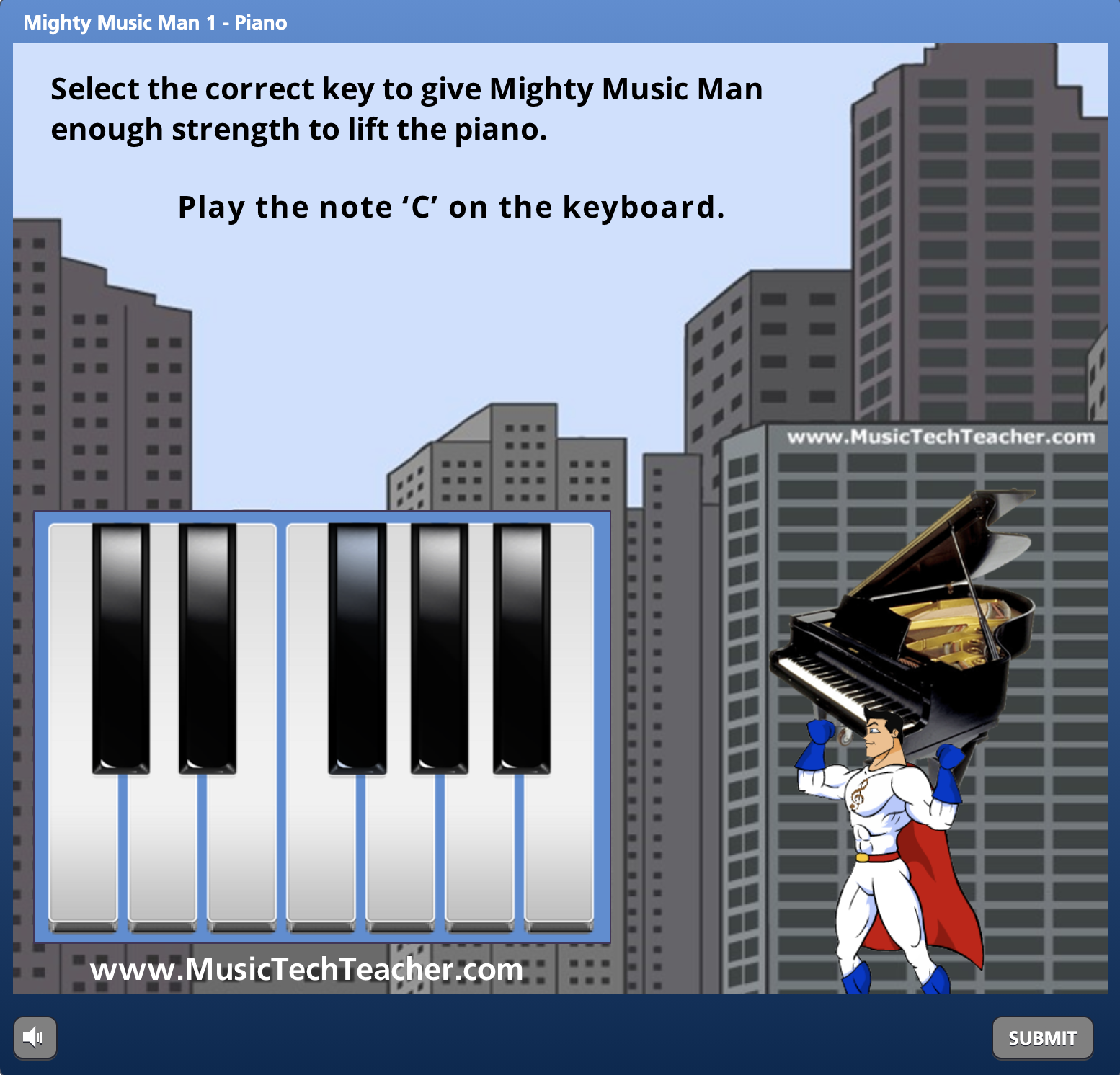

For teachers, Ms. Garrett’s pre-made, printable music theory worksheets are a treasure trove of freebies. They cover everything from notes on the staff, to composers, to mazes that spell out words. She even has fully-designed music lesson plans (note: they are several years old) to help teachers build ideas for their own, more-current lessons.

“Hookpad” by Hooktheory
Best for: Older Secondary Music Classrooms
Hooktheory was designed by three doctoral students from UC Berkeley. It is a combination of interactive curriculum and advanced music composition software to help students both understand music theory and put that knowledge into practice.
Here is a video about Hooktheory’s software, “Hookpad”:
Hookpad employs an incredible amount of “magic.” Students simply create their melody on the piano roll at the top of the screen and either manually enter or ask for a “magic” chord progression which fits with it. They can also hear their song played with different harmony, percussive elements, and backing instrumentation which all follows their song. They can hear their song as an orchestral ballad, a jazz interpretation, or in hip-hop style with just a click of a button.
This manner of composition allows your students to spend their time writing the melody while also getting the benefits of having a full orchestration soundtrack. It certainly helps keep the creativity flowing! To view a full interactive sample of Hookpad, click here!
Beyond Hookpad, Hooktheory also hosts a free “TheoryTab Database” which contains at the time of this writing over 25,000 popular songs with verses and choruses encoded in Hookpad. You can simply type in the song title of a popular song and view the chord progression of the song and play with the tempo, the key, and the mode of the piece. You can even view many songs that use a given chord progression by exploring the TheoryTab Trends tool.
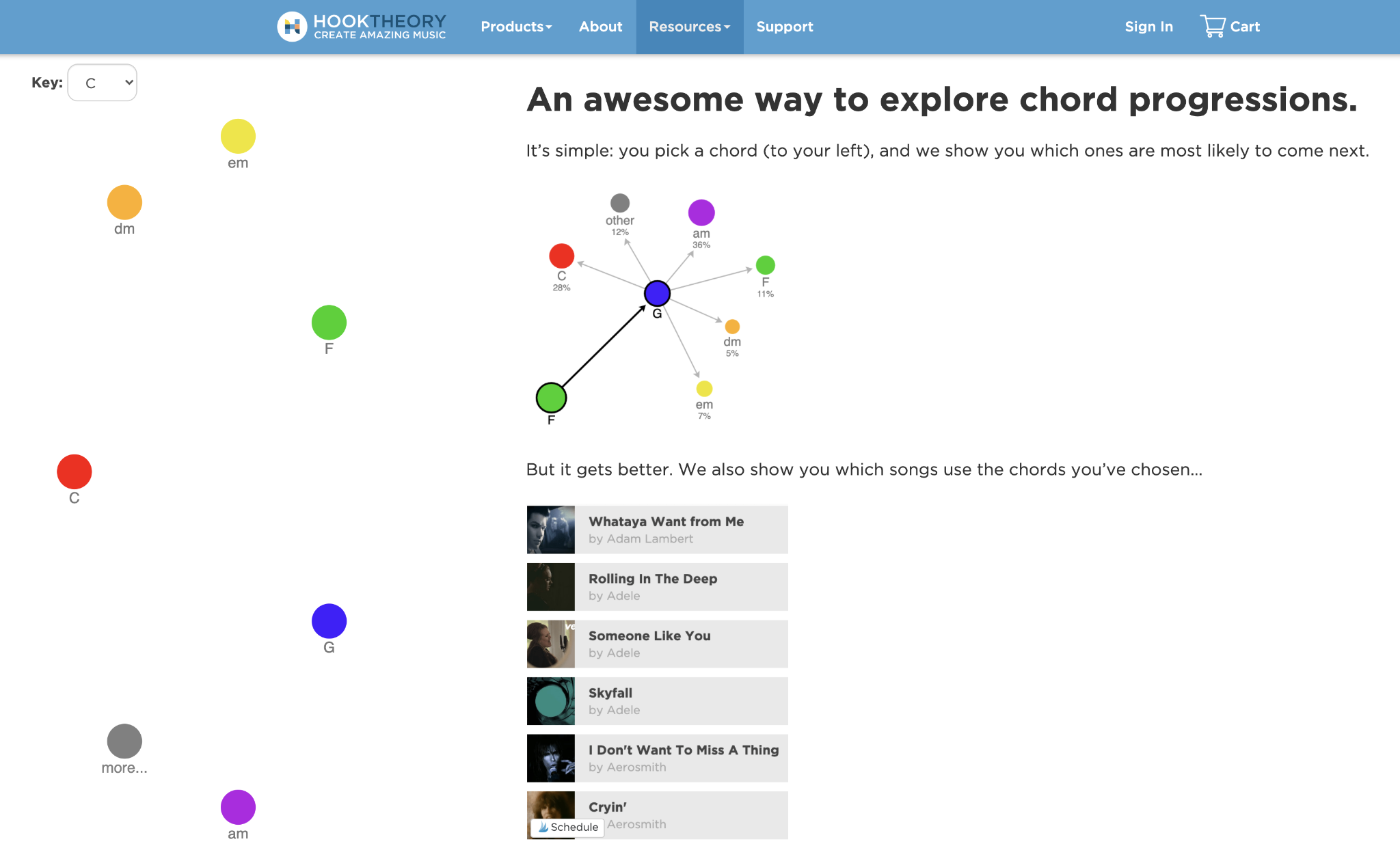
If you are looking for an amazing music theory “textbook” that incorporates popular songs into an easy-to-understand interactive course, Hooktheory also has two levels of digital, immersive textbooks that coordinate with the Hookpad system. You can check those out by clicking here!
Hooktheory also operates a full Youtube channel. Check it out for more helpful tips and tricks for music theory and composition in the classroom!
Solfeg.io
Best for: Secondary Music Classrooms (some songs suitable for Primary Classrooms)
Solfeg.io is an incredible website which breaks down popular songs that students know and love and turns them into engaging music theory lessons.

Solfeg.io’s platform allows you to isolate different chords, change the tempo, take out instruments from the background instrumentation, and so many other things. There are interactive chord visuals for piano, guitar, and ukulele as well as lyrics and standard percussion notation.

There are also dozens of free music lesson plans on the Resources Page which are designed for both online, virtual learning as well as in-person lessons. Each lesson recommends popular songs on the platform to use to teach various concepts as well as discussion questions and activity prompts.

Final Thoughts
There are SO many incredible online resources for teaching music theory and there seem to be more every single day. If you’re stuck and don’t know where to start, begin by comparing some of the different tools in this article. Play around with some websites and games. Get back into the “play” mindset since that is where your students will be coming from.
Here are some final guiding questions:
- How can I help my students relate to this? How can I make this “come alive” for them?
- How can I allow my students to get hands-on in their learning? What can they experiment or play with?
- How can I make music theory exciting and engaging?
- What kinds of songs employ the concepts I’m teaching? How can I demonstrate this in the music my students already listen to?
- How can I build this lesson into an opportunity for my students to write music themselves?
Are there any music theory websites that we missed? What are your favorite tips for teaching engaging music theory lessons? Leave a comment on the blog!
Download your copy
Would you like to take a copy of this with you? Click the button below and a copy of this will be sent directly into your inbox.
About the Writer

Katrina Proctor is the Content Manager at Midnight Music and is also a music teacher from Colorado, USA. She has taught middle school music for nearly 10 years in northern Colorado where her passion is low-income students in Title 1 schools.
Currently, Katrina teaches 5th-8th grade chorus, advanced-level chorus, class piano, and general music. She has her Bachelor’s Degree in Music Education & Master’s Degree in Music Education-Choral Conducting from the University of Colorado at Boulder. You can connect with Katrina on Facebook or via her website, She The Teacher.
Looking for More Resources for Music Teachers?
Hello! I’m Katie Argyle – an Australian music technology trainer and consultant with a passion for helping music teachers through my business Midnight Music.
I’m a qualified teacher but no, I don’t currently teach in a school. I help teachers through my online professional development space – the Midnight Music Community – where there are tutorial videos, courses, links and downloadable resources.

I like to focus on easy ways to incorporate technology into what you are already doing in your music curriculum through a range of creative projects. I also run live workshops and have presented at countless conferences and other music education events.
If you want simple, effective ideas for using technology in music education, I would LOVE to help you inside the Midnight Music Community.




2 Comments
Hi Katrina, I have really been trying to increase my music theory foundation so I’ve been looking for an innovative way to do it. I love that you put this together and I’ve already checked out the first couple on the list. I was wondering, did you think one of these was the BEST? I didn’t really see your recommendation. Thanks!
Hi Tim- I’m so glad this write-up was helpful for you. That’s an EXCELLENT question. I’ve used all of these programs fairly often with my 5th-8th graders, but if I had to choose my absolute favorite, it’d be Solfeg.IO. That recommendation stems from my personal philosophy that kids need to meet music “where they are” and what better way to hook them, than with music they already love. I taught primarily students from low-income households who didn’t come into my classes with any music knowledge or appreciation. It took some grit to get them loving it enough to move into theory and history and more classical components. There was no better way to do that than to tell them, “Y’all, we’re going to learn about (tempo/pickups/form, etc.) by playing some XXXTentacion and Billie Eilish.”
In addition to ensembles, I taught Piano and Guitar classes (primarily at the 7th-8th grade level) and used Solfeg.IO lessons and music all of the time. The lesson library is massive and constantly growing and I was able to build in lessons about theory and history around songs my students knew– it was a gamechanger for those hard-to-reach students.
Once the door to a love of music is open, then definitely moving into more advanced theory and learning tools like Corridor or HookPad are fantastic for older students looking for some fun new musical challenges. Hope this helps!