This is a lesson by Katrina Proctor, Content Manager at Midnight Music.
As a music educator, you’re not just teaching your students how to read notes on a page or play an instrument. You’re cultivating a deeper understanding and appreciation for the rhythmic pulse that underpins all music – the beat. Here’s an interactive lesson plan to help your students gain a better grasp of beats and rhythm.
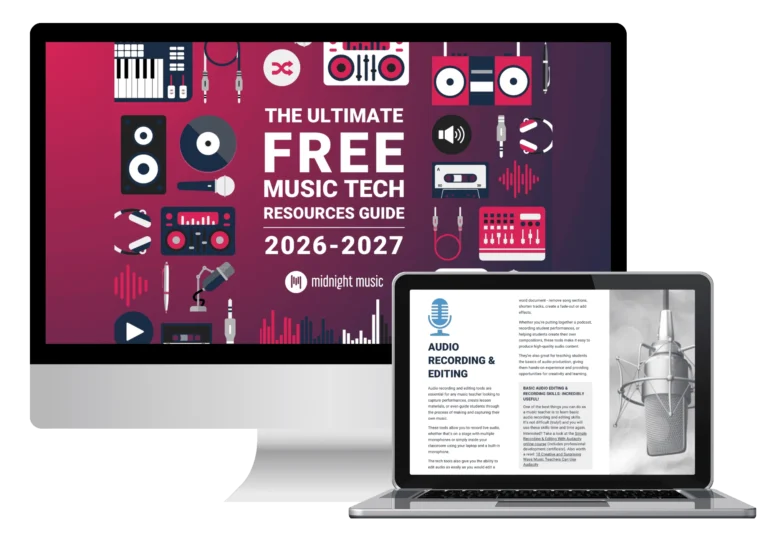
This lesson plan is designed for students from the 6th to 10th grade and can be completed within 60 minutes, spread across one or two lessons. The core idea is simple yet impactful: it engages students in reverse engineering and replicating drum patterns using the Musicca Drum Machine (or another drum machine of your choosing). The Musicca Drum Machine is just one of the many resources available in the Ultimate Free Music Tech Resources Guide – grab your free copy here!

The Goal
The goal of this lesson plan is to engage students’ interactive exploration of beats and rhythm. Students will listen to different beat examples, identify their various components, and then use the Musicca Drum Machine to replicate the beats they heard. This process not only allows them to understand the role of different drum components in creating a beat but also offers a platform to collaborate with peers, compare, and refine their beat compositions.
Materials Needed
For this lesson, you’ll need:
- Lesson plan (grab your free copy by clicking any of the download links on this page!)
- Computers or other devices with sound and internet access
- Headphones for students
- Pencils
- Rhythm track samples (available in the Midnight Music Community or create your own)
- Student worksheets (available in the Midnight Music Community or create your own)
How to Make Rhythm Track Samples
For this activity, you must create audio recordings of different rhythmic patterns from the Musicca Drum Machine (or another drum machine of your choosing) for students to listen to.
For our lesson, we also added a click-track to each recording to help students distinguish the steady beat. It will involve recording a single drum line (hi-hat, bass drum, snare drum etc.) and then adding a synced click-track/metronome to the track in audio editing software (GarageBand, Soundtrap, Bandlab, Audacity, etc.) Not sure where to start with this software, check out my GarageBand for Mac, Soundtrap & Bandlab lesson plans & teacher tips course inside the Midnight Music Community.
If you’re short on time and want all samples & worksheets provided, you can also join us in the Midnight Music Community for the complete done-for-you lesson pack! More information about that is below.
Get the Full Lesson Pack in the Midnight Music Community
If you’d like rhythm audio samples and worksheets already created for you, they’re all included in the Midnight Music Community membership (which you can learn all about here)!
Inside the lesson pack, you’ll receive:
- Level 1 Worksheets: 3 percussion lines + 1 combined final drumbeat
- Level 2 Worksheets: 6 percussion lines + 1 combined final drumbeat
- Answer key for both worksheet sets
- Audio samples for all individual percussion lines (with click-track)
- Combined audio tracks for both completed drumbeat patterns

Let's Get Started
The lesson starts by introducing the concept of reverse engineering. Students will learn the skills of audiation and boost their active listening and rhythmic comprehension. To do this, students will first listen to the first sample percussion line (given as an Mp3).
Students will pay attention to things like on-beat/off-beat sounds, sequences, and repetitions. After actively listening to the sample rhythm, they are encouraged to experiment with the Musicca Drum Machine to match and try to recreate the sample rhythm.
Once the percussion line has been successfully recreated, students will copy the drum machine’s percussion pattern (the visual beat pattern) onto their worksheet by coloring in the drum machine grid.
Here’s an example of the drum grid:

Each line of the drum grid is separated out by numbers showing you the beat number and each beat is subdivided into sixteenth notes/semiquavers.
Collaborative Learning
Once students have matched the first example’s beat, they will collaborate with peers to share their recreated beats. This allows them to learn from each other’s techniques.
Their recreated beats are then discussed as a class, shedding light on the different patterns and listening techniques used and how to troubleshoot if they get stuck.
The Solo Act
Students then continue working on the remaining examples independently or in pairs. After completing their worksheet, they will create a master grid by integrating all the percussion linesthey discovered onto one drum grid on their worksheet. Then, they create a final version on the drum machine that ties in all the different percussion lines they discovered on their worksheet.
Assessment Time
The lesson concludes with an assessment where students notate and then play their final drum pattern for the class or a partner. This is an opportunity to compare the patterns students have come up with and engage in a final discussion if there are any differences.
Extension Opportunity
A more challenging extension of the lesson is having students turn their percussion lines into traditional/standard notation using single-line percussion staves or 5-line drum set notation. You can do this in any notation program you’d like (Finale, Sibelius, Noteflight, Flat, etc.)
Wrapping Up
The lesson ends with a discussion where students reflect on their learning journey. They are asked questions like how they could tell when a sound was on a beat or off-beat, what was the most challenging line to figure out, whether the metronome was distracting or helpful, how their process changed as they went through the lines, and how they would describe the timbre of different percussion instruments.
This lesson plan is more than just an exercise in listening and recreating drum beats. It’s an exploration of rhythm and a dive into the nuances of percussion through teamwork. We hope you enjoy this interactive, supportive, and encouraging way to make teaching rhythm more engaging and meaningful.
What questions do you have about this lesson or the Midnight Music Community? Leave a comment below!
About the author

Katrina Proctor is the Content Manager at Midnight Music and is also a former music teacher from Colorado, USA. She taught middle school music for nearly 10 years in northern Colorado, where her passion is low-income students in Title 1 schools. Katrina has taught 5th-8th grade chorus, advanced-level chorus, class piano, general music, band, and orchestra. She has her Bachelor’s Degree in Music Education & Master’s Degree in Music Education-Choral Conducting from the University of Colorado at Boulder. You can connect with Katrina on Facebook or via her website, She The Teacher.
Want more resources for music tech teachers?
Hello! I’m Katie Argyle – an Australian music technology trainer and consultant with a passion for helping music teachers through my business Midnight Music.
I’m a qualified teacher but no, I don’t currently teach in a school. I help teachers through my online professional development space – the Midnight Music Community – where there are tutorial videos, courses, links and downloadable resources.

I like to focus on easy ways to incorporate technology into what you are already doing in your music curriculum through a range of creative projects. I also run live workshops and have presented at countless conferences and other music education events.
If you want simple, effective ideas for using technology in music education, I would LOVE to help you inside the Midnight Music Community.